
GaN Chargers vs Regular Chargers: What's the Difference?

GaN charging technology is everywhere now, and manufacturers love touting it as "revolutionary." But are GaN chargers really better than traditional chargers? Let's cut through the marketing and look at the real differences.
What is GaN?
GaN stands for Gallium Nitride, a semiconductor material used in the internal components of chargers. Traditional chargers use silicon semiconductors, which have been the standard for decades.
The key difference? GaN is much more efficient at conducting electricity than silicon. This efficiency translates to several real-world benefits that matter to you. To understand the full picture of how USB-C Power Delivery works and why the charger's semiconductor technology matters, see our technical guide.
Simple analogy:
Think of silicon as a two-lane highway and GaN as a six-lane highway. More lanes (GaN) means less traffic congestion (heat) and faster flow (efficiency), even with the same number of cars (power).
Key Differences: GaN vs Regular Chargers
GaN Chargers
Up to 50% smaller and lighter than traditional chargers with the same power output. A 100W GaN charger can be the size of a 60W traditional charger.
Regular Chargers
Larger and heavier due to bulkier internal components needed to manage heat and power conversion.
GaN Chargers
Run significantly cooler because GaN conducts electricity more efficiently. Less energy is lost as heat, making them safer and more comfortable to handle.
Regular Chargers
Can get quite hot during use, especially at higher wattages. This heat is wasted energy and can feel uncomfortable when touched.
GaN Chargers
Typically 90-95% efficient, meaning less energy is wasted. This translates to lower electricity bills and less environmental impact.
Regular Chargers
Usually around 80-85% efficient. More energy is lost as heat, which means you're paying for power that never makes it to your device.
Based on published GaN IC manufacturer specifications and independent measurements from the USB-C testing community, GaN chargers typically achieve 90–95% power conversion efficiency compared to 80–85% for traditional silicon designs — a difference you feel as less heat and smaller size.
GaN Chargers
Generally 15-30% more expensive than equivalent traditional chargers, though prices are dropping as the technology becomes more common.
Regular Chargers
More affordable upfront, especially for basic models. Good budget option if size and weight aren't priorities.
Should You Buy a GaN Charger?
- You travel frequently and want a compact, lightweight charger — see our picks for the best GaN chargers for travel
- You need high wattage (65W+) but want a smaller form factor — check our guide to the best 100W USB-C charger
- You charge multiple devices simultaneously and need efficient power distribution
- You care about energy efficiency and reducing heat output
- You're replacing an old charger and want the latest technology
- •You're on a tight budget and size doesn't matter to you
- •You only need basic, low-wattage charging (under 30W)
- •Your charger stays plugged in one place and never moves
- •You already have a working charger that meets your needs
Bottom line:
For most people upgrading or buying a new charger, GaN is worth the small premium. The benefits in size, heat, and efficiency are real and noticeable. If you need high-power charging for laptops or multiple devices, consider compact 100W GaN chargers that combine maximum output with minimal size. However, if you have a working traditional charger, there's no urgent need to replace it—they still work perfectly fine.
Quick Comparison
| Feature | GaN Chargers | Regular Chargers |
|---|---|---|
| Size | Up to 50% smaller | Larger & bulkier |
| Weight | Significantly lighter | Heavier |
| Heat Output | Runs cooler | Gets warmer |
| Efficiency | 90-95% | 80-85% |
| Charging Speed | Same as regular | Same as GaN |
| Price | 15-30% more expensive | More affordable |
| Best For | Travel, multi-device charging, high wattage | Budget users, stationary charging |
Frequently Asked Questions About GaN Chargers
What are GaN chargers and how do they work?
GaN chargers use Gallium Nitride semiconductors instead of traditional silicon. GaN conducts electricity more efficiently with less resistance, allowing power components to be smaller and generate less heat. This efficiency enables manufacturers to build compact, high-wattage chargers that run cooler than silicon-based alternatives.
Do GaN chargers charge faster than regular chargers?
No, GaN chargers do not charge devices faster than traditional chargers of the same wattage. A 65W GaN charger and a 65W silicon charger deliver identical charging speeds. The advantage of GaN is size reduction and improved efficiency, not faster charging.
Are GaN chargers safe for my devices?
Yes, GaN chargers are safe. They use the same USB Power Delivery protocols as traditional chargers and include identical safety features: overcurrent protection, overvoltage protection, short circuit protection, and thermal management. GaN chargers are certified by the same safety organizations (UL, CE, FCC) as silicon chargers.
How much smaller are GaN chargers compared to regular chargers?
GaN chargers are typically 30-50% smaller than equivalent silicon chargers. A 100W GaN charger can be as compact as a traditional 60W charger. The size reduction is most noticeable in high-wattage chargers (65W and above).
Why are GaN chargers more expensive?
GaN technology requires more expensive semiconductor materials and manufacturing processes compared to silicon. However, prices have decreased significantly since 2020 as production scales up. The current premium is typically 15-30% over traditional chargers, down from 50-100% in earlier years.
Do GaN chargers work with all USB-C devices?
Yes, GaN chargers are fully compatible with all USB-C devices. They use standard USB Power Delivery protocols and will work with any device that charges via USB-C, including laptops, phones, tablets, and accessories. There is no compatibility difference between GaN and silicon chargers.
GaN Chargers We've Tested
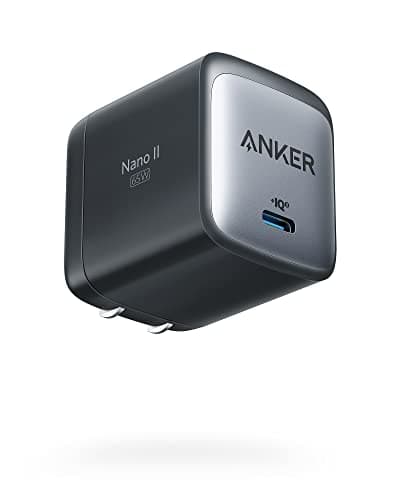
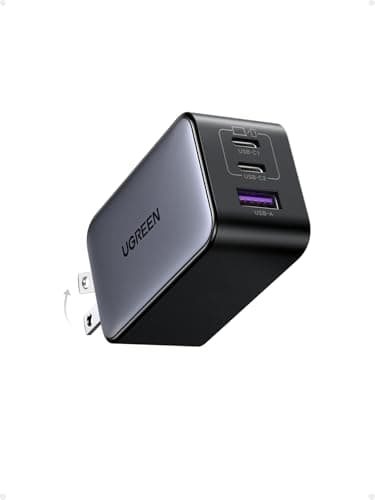
Both of these show the size and heat advantage described above at the 65W tier, where most people actually charge. For higher wattage and travel-specific picks, see our GaN travel charger guide.
Key Specifications
- 65W output
- GaN II semiconductor
- Foldable plug
- PPS support
- Single USB-C port
Pros
- Roughly half the size of an equivalent silicon 65W brick
- Runs cooler under sustained load
- Foldable prongs survive being thrown in a bag
- Charges most ultrabooks at full speed
Cons
- Single port only
- 65W is not enough for 16-inch workstation laptops
Why it's a good choice
This is the clearest demonstration of the argument on this page. A silicon 65W charger is a bulky brick; this delivers the same 65W in something close to the size of an old phone charger. The efficiency gain is what makes that possible — less energy wasted as heat means less material needed to dissipate it. For a single-laptop traveller it is the easiest upgrade to justify.
✓ Buy if you have:
MacBook Air and ultrabook owners, travellers cutting bag weight, anyone replacing a bulky OEM brick
✗ Skip if you have:
Users charging more than one device at a time, and anyone with a laptop that needs 100W or more
Best for:
Seeing the size difference GaN makes in the most direct way possible
Key Specifications
- 65W total output
- 3 ports (2C + 1A)
- GaN technology
- Foldable plug
- PPS support
Pros
- Three ports in a body smaller than most single-port silicon chargers
- Cheaper than many single-port GaN options
- Handles laptop, phone and earbuds together
- Cool running under continuous load
Cons
- 65W splits across ports when all are in use
- Not enough for high-wattage laptops
Why it's a good choice
GaN's efficiency advantage compounds when you add ports: the space you save on heat dissipation gets spent on connectors instead. Three ports at 65W in this footprint would be impossible with silicon. This is where GaN stops being a novelty and becomes the obvious default, and the price is now level with ordinary chargers.
✓ Buy if you have:
Travellers consolidating chargers, couples sharing one outlet, students in dorms with limited sockets
✗ Skip if you have:
Anyone needing full-speed charging on a 100W laptop while other devices are plugged in
Best for:
Replacing three silicon bricks with one GaN unit that still fits a travel pouch
Ready to Choose the Right Charger?
Check out our expert-tested recommendations for the best GaN chargers and traditional chargers.
View Our Top PicksAffiliate Disclosure: As an Amazon Associate I earn from qualifying purchases.