
Can I Bring a Power Bank on a Plane?

Quick Answer
Yes — you can bring a power bank on a plane, but only in your carry-on bag, never in checked luggage. Power banks are lithium-ion batteries, and the FAA and IATA ban them from the cargo hold. The size limit is measured in watt-hours (Wh), not mAh: up to 100Wh is allowed with no airline approval (this covers virtually every consumer bank, including 10,000mAh and 20,000mAh models). Banks rated 100–160Wh need airline approval (usually a maximum of 2), and anything over 160Wh is banned.
The Watt-Hour Rule
Airlines regulate by watt-hours. To convert your bank's capacity:
Wh = (mAh ÷ 1000) × 3.7V
- 10,000mAh ≈ 37Wh — allowed in carry-on, no approval
- 20,000mAh ≈ 74Wh — allowed in carry-on, no approval
- 26,800mAh ≈ 99Wh — the practical maximum that stays under 100Wh
- 27,000mAh+ — may exceed 100Wh; check the printed Wh rating and get approval
The Rules in Detail (TSA / FAA / IATA, 2026)
Power banks are spare lithium-ion batteries, and every major aviation authority treats them the same way. The two rules that matter most are simple:
- Carry-on only, never checked. A lithium battery fire in the cargo hold cannot be reached or extinguished by the crew. In the cabin, a malfunction can be spotted and handled immediately. This is a hard FAA/IATA rule.
- The limit is 100Wh without approval. Up to 100Wh: no approval needed. 100–160Wh: airline approval required, usually max 2 per passenger. Over 160Wh: banned on passenger aircraft.
- Protect the terminals. Keep banks in original packaging or a pouch so the ports can't short-circuit against keys or coins. Several airlines now require this for spare batteries.
New for 2025–2026: a growing number of airlines now require power banks to be kept accessible and NOT used or charged inside the seat pocket or overhead bin — some ask that the bank stay in view on your tray while charging so overheating is noticed quickly. This is an evolving rule that varies by carrier, so check your specific airline's current policy before you fly.
Is My Power Bank Airline-Legal? (Capacity → Wh → Allowed)
Find your bank's capacity below. All values assume a 3.7V lithium-ion cell. When in doubt, read the Wh rating printed on the bank itself — it's the number airlines actually check.
| Capacity (mAh) | Watt-hours (Wh) | Carry-on Status | Notes |
|---|---|---|---|
| 5,000mAh | ~18.5Wh | Allowed (carry-on) | No approval needed |
| 10,000mAh | ~37Wh | Allowed (carry-on) | No approval needed — safest |
| 20,000mAh | ~74Wh | Allowed (carry-on) | No approval needed |
| 26,800mAh | ~99Wh | Allowed (carry-on) | Practical maximum — right at the line |
| 27,000mAh+ | 100Wh+ | Approval required / may be banned | 100–160Wh needs airline approval (usually max 2); over 160Wh is banned |
Bottom line: nearly every power bank you can buy as a consumer (5,000–26,800mAh) is under 100Wh and allowed in carry-on with no approval. You only need to think twice at the very high end (27,000mAh+).
3 Airline-Legal Power Banks We Recommend for Flying
Every pick below is well under the 100Wh limit, so it flies in your carry-on with zero airline approval. We note each bank's watt-hours and exactly why it's airline-legal. See our full laptop power bank guide for more options.
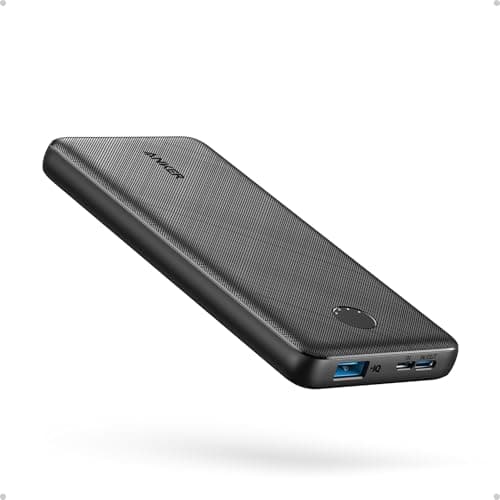
Anker PowerCore 10,000mAh
- 10,000mAh ≈ 37Wh — well under the 100Wh limit, allowed in carry-on with zero airline approval
- Pocket-sized and light — fits in a jacket pocket or seatback bag
- USB-C input/output for phones, earbuds, and small tablets
- 1.5–2 full charges for most modern phones
- No checked-bag worry: keep it in your carry-on every time
Pros
- +37Wh is far below the 100Wh cap — the most worry-free option for any airline worldwide
- +Small and light enough that you'll actually carry it through security without a second thought
- +Inexpensive — easy to replace if lost during travel
Cons
- −10,000mAh won't fully charge a laptop — it's a phone-and-tablet top-off bank
- −Single high-power output — not a multi-device charging hub
Best for: Travelers who just want a phone top-off that is guaranteed airline-legal everywhere and never has to be thought about at security.
Who should skip: Anyone who needs to charge a laptop in flight. For a laptop, step up to a 100W bank below (still under 100Wh).
At roughly 37Wh, this bank sits so far below the 100Wh threshold that no airline on earth will question it. It's the simplest possible answer to "can I bring this on a plane?" — yes, in your carry-on, every time.
See Current Price on Amazon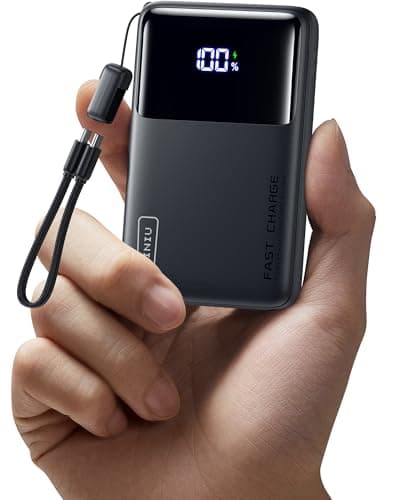
INIU Ultra Compact 10,000mAh 45W
- 10,000mAh ≈ 37Wh — comfortably under the 100Wh carry-on limit, no approval needed
- 45W USB-C Power Delivery — fast-charges phones and tops off small laptops in a pinch
- One of the thinnest 10,000mAh banks available — credit-card footprint
- USB-C and USB-A outputs to charge two devices at once
- Light enough to live permanently in a travel bag
Pros
- +45W USB-C is unusually fast for a bank this small — useful for fast phone and tablet charging
- +37Wh keeps it firmly airline-legal in carry-on on any carrier
- +Slim profile slides into a passport wallet or seatback pocket easily
Cons
- −10,000mAh is light on capacity for a full laptop charge
- −45W tops off a laptop slowly — fine for emergencies, not a primary laptop charger
Best for: Frequent flyers who want the smallest possible bank that still fast-charges a phone and can nudge a laptop along — all while staying airline-legal.
Who should skip: Travelers who regularly run a laptop off battery for hours — you'll want the 20,000mAh 100W bank below for real laptop runtime.
The INIU packs 45W USB-C into one of the slimmest 10,000mAh shells you can buy, and at ~37Wh it's never a problem at security. It's the bank to grab when carry-on space and weight matter most.
See Current Price on Amazon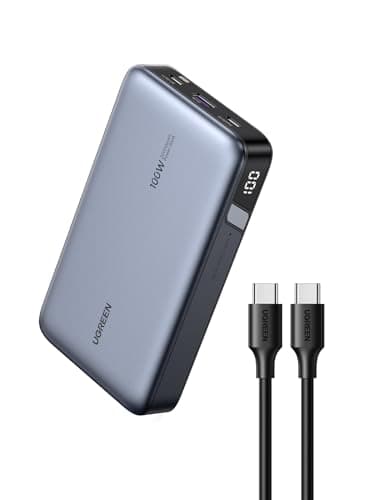
UGREEN 20,000mAh 100W Power Bank
- 20,000mAh ≈ 74Wh — still comfortably under the 100Wh limit, allowed in carry-on with no approval
- 100W USB-C output — charges most 14" laptops at or near full speed
- Charges a laptop, phone, and earbuds together from multiple ports
- About 1 full laptop charge or several phone charges per trip
- The practical sweet spot: maximum useful capacity that's still hassle-free at security
Pros
- +100W output is enough to run and charge most ultrabooks during a flight
- +74Wh leaves a clear margin under the 100Wh cap — no airline approval required
- +Big enough for a full day of devices without recharging the bank itself
Cons
- −Heavier and bulkier than the 10,000mAh picks — it's a backpack bank
- −At 74Wh it's near (but safely under) the limit — don't confuse it with 26,800mAh+ banks that can exceed 100Wh
Best for: Travelers who need real laptop runtime in the air and want the most capacity that's still comfortably airline-legal without paperwork.
Who should skip: Light packers who only top off a phone — the 10,000mAh banks above are half the weight and just as legal.
At ~74Wh, the UGREEN 20,000mAh hits the practical maximum: enough 100W power to charge a laptop, yet far enough below 100Wh that no gate agent will blink. It's the best balance of capacity and travel simplicity.
See Current Price on AmazonPower Banks on Planes: FAQ
Related Guides
Best Power Banks for Laptops
Laptop-grade power banks by capacity, wattage, and airline carry-on rules.
Best GaN Chargers for Travel
Compact, multi-device GaN wall chargers that pack light for flights and hotels.
Best Power Banks for iPhone 17
Pocket banks sized to fully charge the latest iPhones — all airline-legal.
Summary
You can bring a power bank on a plane, but only in carry-on baggage — never in checked luggage, because lithium-ion batteries are banned from the cargo hold by the FAA and IATA. The limit is measured in watt-hours, not mAh: up to 100Wh needs no approval, 100–160Wh needs airline approval (usually max 2), and over 160Wh is banned. Convert with Wh = (mAh ÷ 1000) × 3.7V, so 10,000mAh ≈ 37Wh, 20,000mAh ≈ 74Wh, and 26,800mAh ≈ 99Wh (the practical maximum). Nearly all consumer power banks are under 100Wh and fly freely in carry-on. In 2025–2026, several airlines added rules requiring power banks to be kept accessible and not used inside seat pockets or overhead bins — check your carrier's current policy before flying.